
The real estate and architecture industries largely agree on the goal: we need to transition to a circular business model. Yet many circular sustainability initiatives in the real estate sector remain limited. Why? Part of the answer lies in how we measure success.
Circularity and sustainability are complex. In a circular procurement decision in the real estate industry, materials and interiors are easily evaluated from a short-term perspective, more like a snapshot. The calculation only shows what it costs right now. The result is that the cheapest reused product wins automatically — regardless of how short its remaining lifespan is.
Because remaining useful life is invisible in the snapshot calculation, a product that lasts three years is scored the same as one that lasts fifteen. At the same time, new, sustainable products designed for disassembly and backed by guaranteed buy-back agreements can be rejected, simply because they look expensive in the moment. The future replacement need and emissions simply end up in a later budget and on a future carbon account — as someone else’s problem.
We have to stop rewarding the opposite of what we are trying to achieve.
Moving the Measurement Point: 4 KPIs for Real Value Preservation
Within the Vinnova-funded research project NETRACCI, together with industry partners such as H&M, Vasakronan, Platzer, and Areim, we have developed a methodology to help solve the measurement challenge. The key is to move from purchase price to evaluating climate impact and life-cycle cost per year of use.
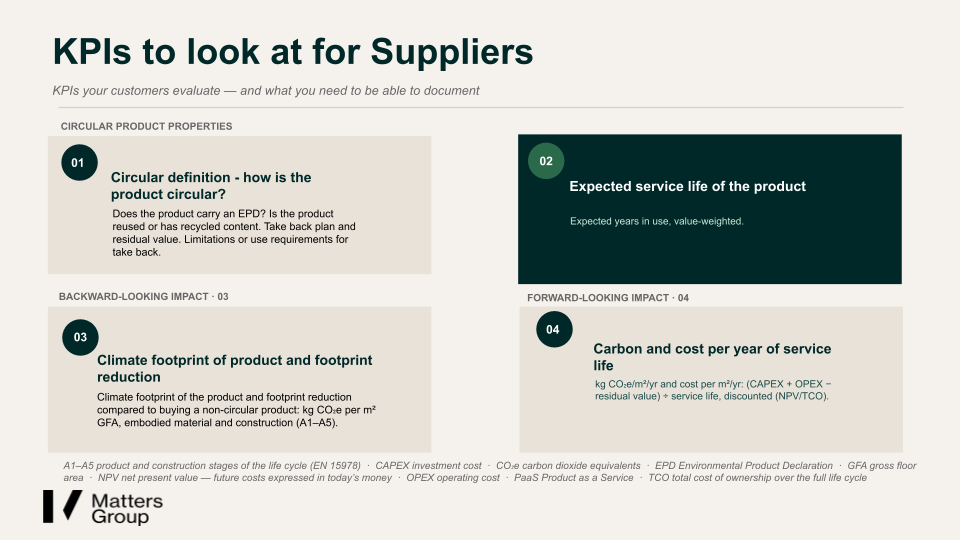
To make this possible and traceable, we established four specific KPIs, divided into three categories: circular properties, the effect of what has already happened (backward-looking), and the effect of what shapes the next cycle (forward-looking).
Circular properties
1. Circular definition — how is the product circular?
Is there an EPD? Is the product reused, or does it contain circular content? Is there a buy-back or take-back plan? What are the requirements or constraints for take-back and residual value?
2. Expected lifespan: measured in years, weighted by purchase value.
This is the engine of the system. Without this variable, the cheapest short-lived product wins every time.
Backward-looking effect (what has already happened)
3. Climate footprint per m²: two parts.
- Climate footprint per m² (kg CO₂e / m² GFA). Covers materials and the construction phase (A1–A5).
- Reduced climate impact compared with a non-circular product.
Forward-looking effect (what shapes the future)
4. Carbon and cost per year: (kg CO₂e/m²/year and SEK/m²/year). Calculated as (CAPEX + OPEX − residual value) divided by the product’s expected lifespan. It is this measure that actually allows us to rank two investment alternatives against each other fairly.
Let’s take a concrete calculation example from the pilot: If we compare a reused office chair for SEK 800 (with 4 years of remaining lifespan) with a new chair, designed for disassembly, for SEK 4,000 (with a 15-year lifespan and a buy-back value of SEK 800).
- In a traditional snapshot, the reused chair looks 5 times cheaper.
- Viewed per expected lifespan (KPI 2), the reused chair costs SEK 200/year, while the new innovative chair costs SEK 213/year. They are nearly equivalent. If we give the reused chair 12 years of remaining lifespan, it wins by a wide margin (SEK 67/year). The methodology does not penalise reuse — it simply ensures that we compare apples with apples.
Payoff: Bridging the Critical Gap Between the Drawing Board and the Spreadsheet
This brings us to one of the industry’s challenges — the potential gap between the architects’ solutions and the property owners’ calculations and profitability requirements. The project helps the two sides meet by implementing the right measurement methodology — such as the four KPIs and LCC per year of use — creating a common language. Architects can show the financial benefit of circular design more clearly, and property owners get a decision basis that genuinely builds long-term and multiple value.
Think. Act. Matter.
Navigating the future and creating circular profitability requires a new logic for the business model. At Matters Group, we are neither a traditional management consultancy, a PR agency, nor a sustainability auditor focused solely on compliance. We are your partner for business-driven circular transformation.
By using the circular economy as a tool and an engine, we help you move from data to intelligence (THINK), transform vision into circular strategy and business innovation (ACT), and finally drive a transformation that generates real, measurable results on the bottom line (MATTER).
What would you need to do to genuinely move your business and your real estate projects forward — and what is holding you back?
Are you interested in hearing about more analyses and methods that can contribute to your development?
Let’s talk.
(NETRACCI is an industrial research project led by Matters Group, co-financed by Vinnova and Net Zero Industries, with participating parties: RISE, KTH, LiU Vasakronan, H&M, Platzer Fastigheter, Areim, Kaminsky Arkitekter, FOJAB, Semren Månsson Arkitekter, Murman Arkitekter, Spectrum Arkitekter, YLLW Factory, Hyfer Objects, Rebel Light, Gärsnäs, Papershell, Relevator, Ogeborg)
Recent Comments